Gold vs Bitcoin: Store of Value or Speculative Asset?

By
 Checked by ,
Updated
As the end of the tax year approaches, many investors are reviewing their portfolios with an eye to resilience and diversification for the year ahead. Among alternatives to traditional stocks and bonds, gold and Bitcoin are often viewed through the same lens. Both have no central issuing authority, neither pays a yield, and Bitcoin is frequently dubbed “Digital Gold”, but beneath those superficial similarities lie very different investment characteristics, histories and roles within investors’ broader strategies.
Bitcoin
Bitcoin was introduced in 2009 with the aim of creating a decentralised digital currency that operates independently of governments, banks, or traditional financial institutions. Unlike fiat currency (such as the US Dollar, Euro or Pound Sterling), Bitcoin is not issued or backed by any central authority. Its supply is fixed at 21 million coins, meaning no more than that can ever exist. This scarcity, combined with its decentralised nature, has led many to refer to Bitcoin as “Digital Gold”. Investors are drawn to Bitcoin primarily for its potential price appreciation rather than any intrinsic use. Its value is determined almost entirely by supply and demand dynamics, market sentiment, and speculation.
The price of Bitcoin is correlated with tech stocks and is often sensitive to regulatory developments, macroeconomic conditions, and investor appetite for risk. While it has attracted substantial retail and institutional attention, it remains a relatively young and volatile asset class. Its price can experience rapid, sometimes dramatic swings, which can create opportunities for high returns but also significant potential losses.
Security is another consideration. Bitcoin requires digital wallets, private keys, and reliance on exchanges, which can be vulnerable to hacks or operational failures. Furthermore, there is no physical form of Bitcoin, so investors must be comfortable holding purely digital assets. Despite these challenges, Bitcoin has seen growing institutional interest, and some central banks are exploring ways to integrate digital currencies into financial systems – though speculation usually focuses on new central bank digital currencies (CBDCs) rather than adopting Bitcoin per se.
Its emerging role as both a speculative asset and potential long-term store of value continues to spark debate among investors, economists, and policymakers. For those willing to tolerate high volatility and embrace the complexities of digital infrastructure, Bitcoin offers a new frontier of investment possibilities.
Gold
Gold has been valued by human societies for thousands of years, with the oldest gold objects dating back to approximately 4600 BC. Unlike Bitcoin, gold’s value is not purely speculative. It is a tangible, physical asset with intrinsic utility. Throughout history, gold has served as money, a symbol of wealth, purity and power, and a medium for trade. Its enduring appeal is rooted in both scarcity and practical applications: beyond jewellery and coinage, gold plays a critical role in technology, electronics, and medicine, making it a versatile and widely demanded commodity. Gold’s limited annual supply, combined with accumulated reserves held by central banks, underpins its stability and reputation as a long-term store of wealth.
Unlike emerging digital assets, gold has a well-established market, recognised by investors worldwide and integrated into central bank reserves. Its market capitalisation is approximately $35 trillion, placing it among the most liquid assets globally.[1]
Gold is often considered a hedge against inflation, currency depreciation, and economic uncertainty. Its low correlation with equities and other financial assets has made it an effective tool for portfolio diversification, offering resilience in times of market stress. Historically, gold has retained purchasing power across generations, providing both security and confidence to investors. While it does not offer a yield or dividends, its perception as a safe-haven and wealth preserver is unparalleled.
For investors seeking a reliable anchor in volatile markets, gold offers a proven historical track record, combining tangible utility with centuries of cultural and economic significance. Its dual appeal as both a luxury good and financial asset ensures that gold remains a cornerstone of balanced investment portfolios.
Bitcoin and Gold Compared
|
Bitcoin |
Gold |
|
|
First Used |
2009 |
c.4600 BC |
|
Source of Returns |
Price Growth |
Price Growth |
|
Issuing Authority |
N/A |
N/A |
|
Market Cap |
c. $1.5 trillion |
c. $35 trillion |
|
Market Maturity |
Emerging |
Established |
|
Supply |
Fixed at 21 million coins |
+1-2% per year from mine production, but finite |
|
Dependence on Technology |
Requires blockchain, internet, electricity |
None |
|
Security Risks |
Hacks, lost wallets/keys, exchange risk |
Physical Theft |
|
Demand Sectors |
Investment |
Investment, Jewellery, Technology, Medical |
|
Owned as Part of Central Bank Reserves |
No |
Yes |
Historical performance highlights the contrasting nature of these two assets. Over recent years, Bitcoin has delivered extraordinary returns at times, driven by speculative interest and digital asset adoption. However, that performance has come with pronounced volatility. Bitcoin’s price can surge or plunge by double‑digit percentages in short periods. In contrast, gold’s price movements have historically tended to be much steadier, with a long history of retaining purchasing power through inflationary periods and economic volatility.
If we take the period of the past 5 years, gold has significantly outperformed Bitcoin, growing 212% compared to Bitcoin’s 38% growth. [2]
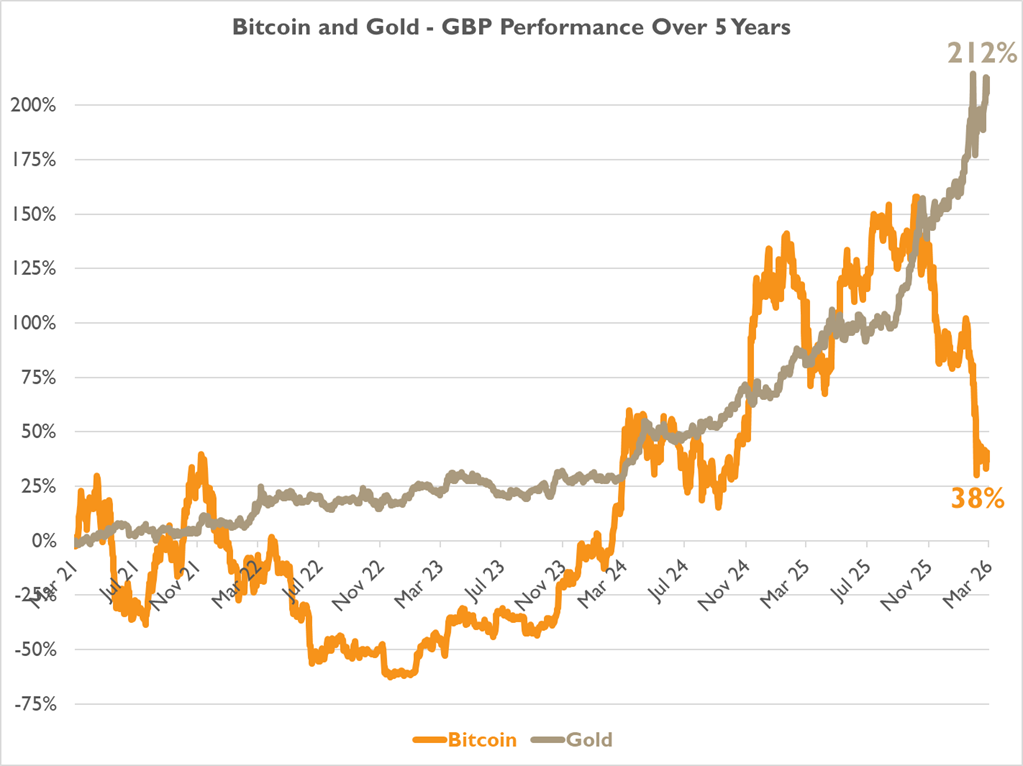
Over this period, Bitcoin was also clearly much more volatile than gold, with an average annualised volatility of around 50%. Gold, by contrast, had a much lower average annualised volatility of around 14%. And while Bitcoin significantly outperformed gold at times, it also significantly underperformed at others. This suggests that these two assets might appeal to different investors with different attitudes to risk; Bitcoin may appeal to investors with a higher risk tolerance and a willingness to withstand sharp price swings, while gold tends to attract those seeking long‑term preservation of wealth and portfolio diversification that is less correlated with equities.
Despite being compared so frequently, Bitcoin and gold have very different behaviours. Gold and Bitcoin are almost completely uncorrelated (-0.02 correlation in this 5-year period). Gold has repeatedly shown its ability to act as a hedge in times of economic stress or currency weakness, a characteristic nurtured over centuries of use. Bitcoin’s performance, by contrast, has been tied to broader risk sentiment, regulatory developments and demand dynamics within digital asset markets. So while these two assets have some similar characteristics (decentralised, demand-based, finite) they’re not interchangeable in a portfolio.
While both Bitcoin and gold share a narrative about limited supply and decentralised appeal, they are fundamentally different assets. Bitcoin is an emerging digital investment, highly volatile with potential for strong returns, but it lacks the long-tested characteristics of a traditional store of value. Gold’s intrinsic qualities, diversified demand, and deep historical track record give it a distinct role in wealth preservation and risk management.
For investors considering the next financial year, understanding these differences is key. Bitcoin may suit those looking for high-risk, high-return opportunities within a speculative allocation. Gold, meanwhile, continues to serve as a resilient cornerstone, offering balance, diversification and long-term wealth preservation that has stood the test of time.
Notes
The content of this article is accurate at the time of publishing, is for general information purposes only, and does not constitute investment, legal, tax or any other advice. Before making any investment or financial decision, you may wish to seek advice from your financial, legal, tax and/or accounting advisers.
>This article may include references to third-party sources. We do not endorse or guarantee the accuracy of information from external sources, and readers should verify all information independently and use external sources at their own discretion. We are not responsible for any content or consequences arising from such third-party sources.
Sources
[1] 219,890 tonnes at $5,000/oz = $35,348,087,115,000. https://www.gold.org/goldhub/data/how-much-gold
[2] From 1st March 2021 to 1st March 2026, BTC/GBP and LBMA PM GBP Gold Prices.