
By
 Checked by ,
Updated
A Trip Down Memory Lane
As we celebrate the 40th anniversary of the first gold Britannia and 30th anniversary of the silver Britannia, let’s first look back nostalgically at how the world looked at each of these pivotal moments:
| Category | 1987 | 1997 | 2026* |
|---|---|---|---|
| No 1 Song | Never Gonna Give You Up - Rick Astley |
Candle in the Wind - Elton John |
Man I Need - Olivia Dean |
| Highest Grossing Film | Crocodile Dundee | The Full Monty | Spider-Man: Brand New Day |
| Most Watched TV | Eastenders (Den Watts divorcing Angie) |
Funeral of Diana, Princess of Wales |
2026 FIFA World Cup: England v Argentina |
| Bestselling Car | Ford Escort Mk4 | Ford Fiesta Mk4 | Ford Puma Mk2 |
| Bestselling Toy | Sylvanian Families | Teletubbies Plush Toys | No Data Yet |
Worth Their Weight
Perhaps the most striking change can be seen in the value of the precious metals themselves.
When the first 1oz gold Britannia was launched in 1987, it retailed for around £330 including VAT. Today, a 1oz gold Britannia is priced at around £3,300 (with no VAT payable), representing an increase of approximately 900%, or ten times the original price.
The gold spot price on the day Britannia launched was £278.73 per ounce. By 30 September 2026, it had risen to around £3,144 per ounce, an increase of more than 1,000%. This represents a compound annual growth rate of around 6.4% over the period.
The story is even more impressive for silver. When the first 1oz silver Britannia was introduced in 1997, the silver it contained was worth around £3. Today, the same ounce of silver is worth around £46. That represents an increase of more than 1,400%, equivalent to a compound annual growth rate of around 9.8% over the past three decades.
| Metal | Price Growth | CAGR |
|---|---|---|
| Gold | +1,028% | +6.4% |
| Silver | +1,400% | +1.8% |
The performance of precious metals can also be compared to other assets and measures that have shaped the UK’s investment market. Average UK property prices have risen by around 609% between October 1987 and the latest available 2026 data, while the FTSE 100 has risen by around 358% over the period.
It is important to note that the FTSE 100 comparison reflects price growth only and excludes dividends, as a Total Return Index is not available for 1987.
Gold and silver prices are as of 30th September 2026. UK property prices from HM Land Registry (Average Price for all property types across the UK). FTSE 100 data is from 14 October 1987 to 29 September 2026 and excludes dividends as Total Return Index is not available for 1987.
The Unchanging Face of Britannia
While the value of the precious metal inside Britannia has changed dramatically, one thing has remained remarkably consistent: the face value stamped on the coin.
The 1oz gold Britannia has a face value of £100. It was £100 in 1987 and it is still £100 today. Of course, £100 does not buy what it once did. According to the Bank of England's inflation calculator, £100 in 1987 is equivalent to around £300.32 today. In other words, prices have risen by around 200% over the period, equivalent to average annual inflation of approximately 2.8%.
The 1oz silver Britannia has a face value of £2. In 1997, that £2 had the purchasing power of around £4.09 today, representing a rise of approximately 105%, with inflation averaging around 2.5% a year.
What would £100 buy in 1987 vs today?
| Product | 1987 | Today | Change | ||
|---|---|---|---|---|---|
| Price | £100 would buy | Price | £100 would buy | ||
| Pints of Milk | 26p | 384 | 58p | 173 | -55% |
| Loaves of Bread | 55p | 181 | £1.34 | 74 | -59% |
| Dozen Eggs | 92p | 108 | £3.93 | 25 | -77% |
| Pints of Lager | 95p | 105 | £4.74 | 21 | -80% |
What would £2 buy in 1997 vs today?
| Product | 1997 | Today | Change | ||
|---|---|---|---|---|---|
| Price | £2 would buy | Price | £2 would buy | ||
| Pints of Milk | 35p | 5 | 58p | 3 | -39% |
| Loaves of Bread | 71p | 2 | £1.34 | 1 | -47% |
| Dozen Eggs | 1.38p | 1 | £3.93 | 0 | -65% |
| Pints of Lager | 1.81p | 1 | £4.74 | 0 | -62% |
The figures provide a useful reminder that while Britannia's denomination has remained unchanged, the purchasing power of the pound has not.
Sources: Office for National Statistics. For October 1987 and average 1997 prices: Dataset MM23 - RPI :Ave price - Milk: Pasteurised, per pint, RPI: Ave price - Bread: white loaf, unwrapped, 800g, RPI Average price - Eggs, per dozen, RPI: Ave price - Draught lager, per pint. For August 2026 prices: Shopping Prices Comparison Tool.
Tax Efficiency
Britannia's story is not only one of changing metal prices. The tax landscape surrounding investment has changed considerably too.
Britannia bullion coins have been exempt from Capital Gains Tax since their launch in 1987 because British legal-tender coins, including Britannias, are treated as currency for CGT purposes. HMRC's current guidance specifically confirms that Britannia gold coins are exempt.
When Britannia launched almost 40 years ago, Britons could make £6,600 profit from selling assets without incurring a Capital Gains Tax bill – adjusted for inflation that equates to around £21,000 in today’s money. However, in recent years the threshold at which you begin to pay Capital Gains Tax (known as the Annual Exempt Amount) has been reduced – from £12,300 in 2022/23 to £3,000 today.
For investors holding assets that are subject to CGT, this reduction means that tax is payable on smaller profits. One result of this is that the proportion of the UK public paying Capital Gains Tax has doubled compared to 1987.
| Tax Year | Annual Exempt Amount | Top Rate |
|---|---|---|
| 1987/88 | £6,600 | 30% |
| 2026/27 | £3,000 | 24% |
Another major tax change impacting decisions to invest in Britannia gold coins is the removal of Value Added Tax on 1st January 2000. As Britain entered the new millennium, legal tender gold coins which became instantly cheaper and more accessible as the then 17.5% tax was no longer chargeable.
| Tax Year | VAT on Gold Coins |
|---|---|
| 1987/88 | 15% |
| 2026/27 | Exempt |
Today it is this combination of VAT and CGT exemption that makes Britannia the go-to choice for many of The Royal Mint’s largest private and corporate investors.
The Nation’s Favourite Britannia
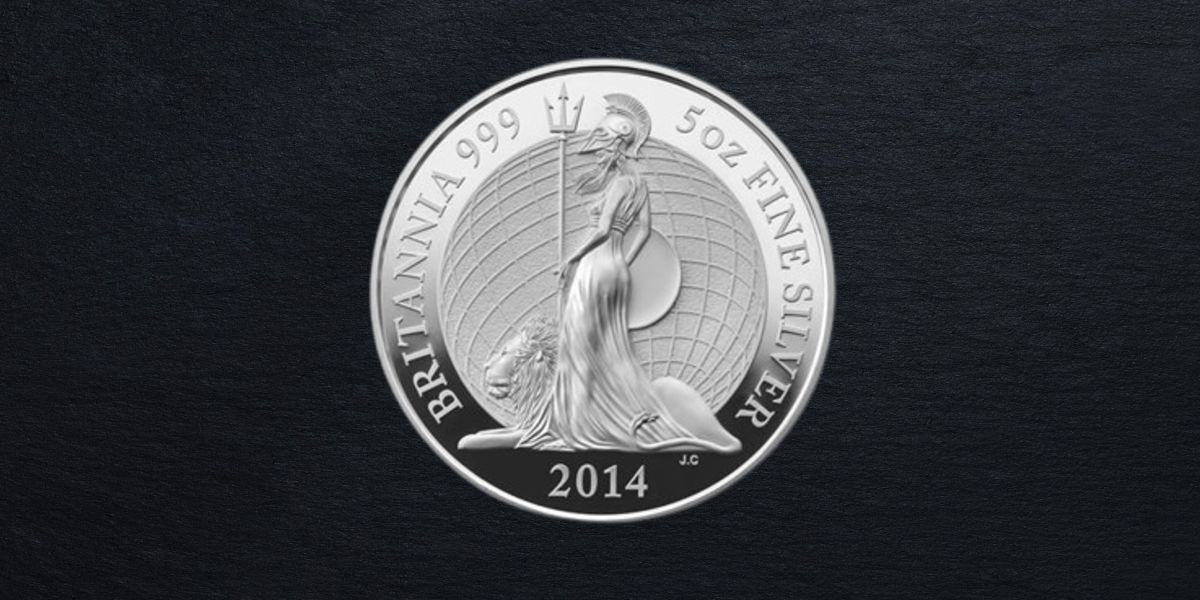
In 2026, The Royal Mint conducted a survey to discover the public’s favourite Britannia design of the past 40 years (excluding Philip Nathan’s timeless original).
Over 1,000 votes were cast and Jody Clark’s 2014 design was the standout favourite, depicting Britannia in a modern neoclassical style strong and elegant standing before the world with the British lion at her side.
Discussing his design in 2014, Jody Clark told The Royal Mint:
“In approaching my design, I started by researching what had gone before. Britannia has appeared in so many different compositions and with such a variety of symbols. I wanted my design to recall her history and tradition but with the elements surrounding Britannia rather than weighing her down.
In my research I found that Britannia often sat on the globe in an imperial fashion. I didn’t think that was a very modern concept. Instead, I decided to place it alongside her. I wanted to make the design appear as if Britannia is moving with the globe, and portray a sense of movement, with flowing elements like her dress. I thought it would be nice to have the contrast of static graphic elements too, like the globe. I found it a real balancing act getting the traditional aspects in whilst giving them a modern twist.
I wanted to include a lion in this Britannia portrayal too because I had decided upon a very feminine and elegant looking Britannia, and I needed the strong presence of the lion to balance the design out. I didn’t want it to be overly soft and flowing. I don’t think a lion had featured for a while either so I knew I wanted to include one in mine.
I added Britannia’s foot at a very late stage. There was a lot of work done at the selection stage to refine the design. It was suggested at a sitting of the Royal Mint Advisory Committee that the design would be enhanced by having her foot showing, and when I thought about it, they were right – it just looked right. I then added the shape of her leg in there too, so you can see the suggestion of her form under the dress.
I am quite humbled by the fact that people seem to like my Britannia design.”
The Britannia Everyone Wanted
Britannia's history has also been shaped by events far beyond the Mint's walls.
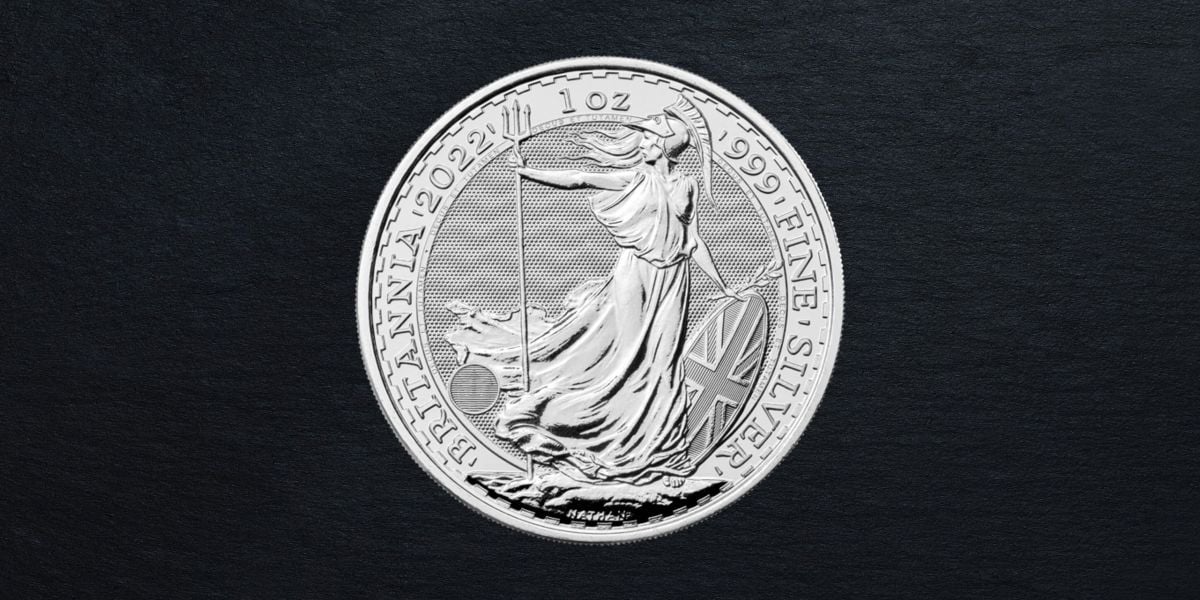
A combination of market forces made the 2022 1oz Silver Britannia the bestselling Britannia coin of all time. The year began amid heightened geopolitical uncertainty following Russia’s invasion of Ukraine, prompting investors to seek out traditional safe-haven assets such as precious metals. At the same time, inflation surged across major markets: UK CPI inflation reached 11.1% in October 2022, a 41-year high, while silver experienced significant volatility, with its price moving by more than 47% between its 2022 high and low. Together, these conditions created a powerful backdrop for demand for physical silver.
The 2022 Britannia also benefited from a unique sense of historical significance. Following the death of Her Late Majesty Queen Elizabeth II in September 2022, collectors rushed to acquire coins bearing her final effigy, with the 2022 Britannia among the most pertinent to feature her portrait. This gave the coin an additional appeal beyond its precious-metal content, combining investment demand with the desire to own a tangible piece of British history.
The result was a remarkable convergence of economic uncertainty, precious-metal investment and collectability. Investors were turning to silver amid inflation and geopolitical risk, while collectors were seeking one of the final Britannia issues of Queen Elizabeth II’s reign. Together, these forces helped propel the 2022 1oz Silver Britannia to record demand – making it the most owned Britannia coin in the series.
A Year Like No Other
If 2022 produced one of the most sought-after Britannias in the series, 2023 produced its most unusual.
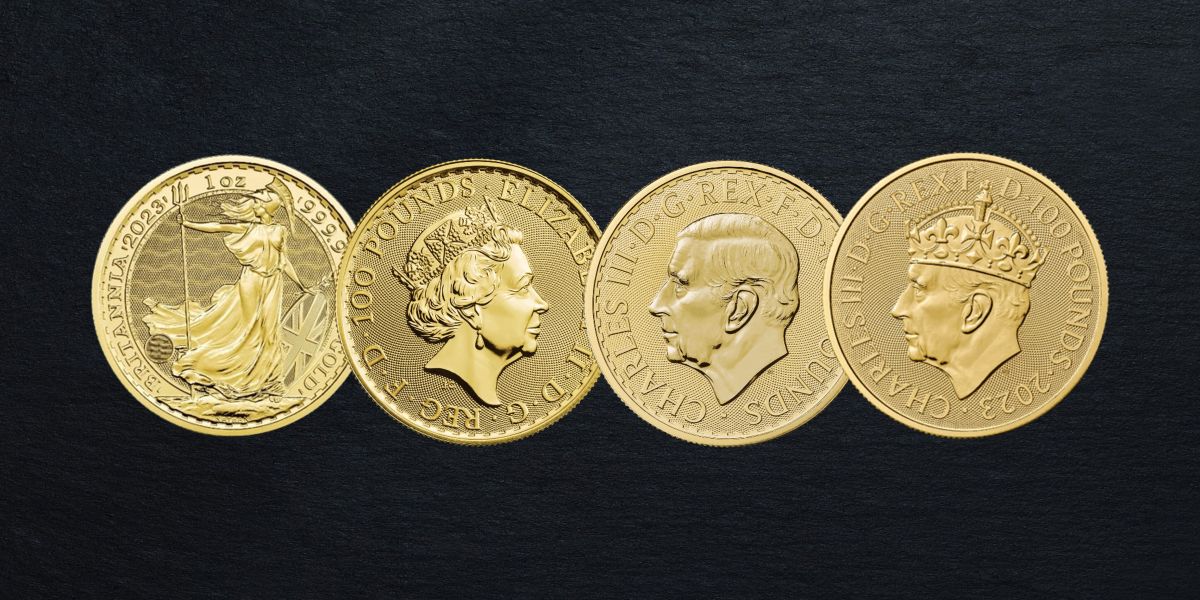
2023 marked the first year in which a monarch other than Queen Elizabeth II appeared on the obverse of a Britannia bullion coin. At the time of Queen Elizabeth II’s passing in September 2022, The Royal Mint had already begun striking 2023-dated Britannia bullion coins bearing Her Late Majesty’s effigy. In the interests of sustainability, and in accordance with the wishes of His Majesty King Charles III, these coins were not scrapped. Instead, a limited number were released featuring Queen Elizabeth II, creating the unusual distinction of coins dated to a year she did not live to see.
Subsequently, The Royal Mint duly began striking new 2023 Britannia coins featuring His Majesty The King’s new official effigy. To mark His Majesty’s coronation in May that year, a limited number of Britannia bullion coins were also minted featuring a crowned portrait of King Charles III.
As a result, while the reverse (‘tails’) of the 2023 Britannia bullion coin remained unchanged, three distinct obverse (‘heads’) designs were used during the year: Queen Elizabeth II’s effigy, King Charles III’s uncrowned effigy, and The King’s crowned coronation effigy. Such was the demand for new King Charles III coins in 2023 that The Royal Mint simplified the crowned obverse, removing Britannia’s traditional castellations from around the edge of the coin. This allowed the same dies to be used to strike coins beyond the Britannia range, helping The Royal Mint meet demand more efficiently.
Rule Britannia!
Four decades after its launch, Britannia is no longer simply a British bullion coin. It has become an internationally recognised part of the global bullion market.
Independent research from Metals Focus has found that The Royal Mint has the largest global market share among major mints for gold and silver bullion coins, with Britannia accounting for a significant proportion of sales.
| Category | Ranking |
|---|---|
| Gold Coins | #1 |
| Silver Coins | #1 |
The Royal Mint has particularly strong market share across Europe and East Asia, reflecting the international appeal of a coin that combines precious-metal content, British heritage and legal-tender status.
Over the past 12 months, Britannia's top five markets have been:
- United Kingdom
- United States
- Germany
- Singapore
- Switzerland
From its launch in 1987 to its 40th anniversary, Britannia has travelled a remarkable distance.
Its denomination has stayed the same. Its precious-metal content has remained constant. Its designs have evolved, and the world around it has changed dramatically.
Yet the central idea behind Britannia has remained remarkably familiar: a bullion investment coin, made by the The Royal Mint, representing a piece of British history that can be held in the hand. As Britannia enters its fifth decade, that story continues…