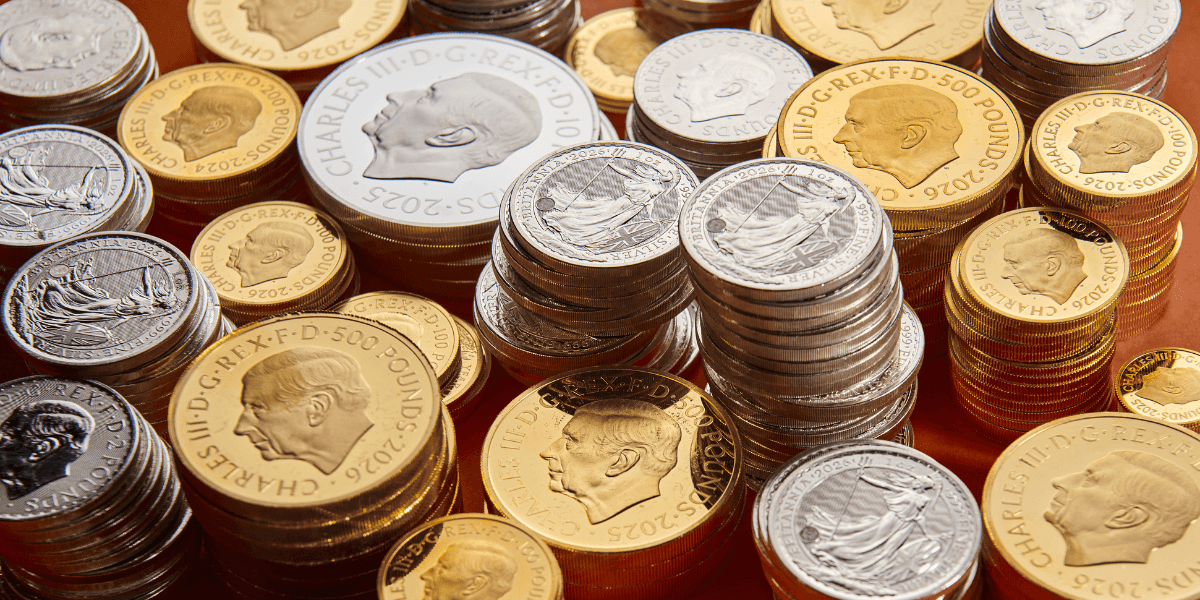
Investing in physical bullion comes with its own language, which can feel unfamiliar at first. This A–Z guide explains the key terms you’ll encounter, helping you buy, store, and sell gold, silver and platinum with confidence.
Allocated Storage
Bullion that is stored securely and specifically assigned to you. You own identifiable bars or coins. Any coins or bars you buy for storage in The Royal Mint’s Vault are stored on an allocated basis.
Assay
The process of testing and verifying the purity of a metal, e.g. that it is 99.99% gold. The Royal Mint is home to The King’s Assay Master, an individual responsible for upholding the integrity of UK hallmarking and the four assay offices in London, Sheffield, Birmingham and Edinburgh.
Assay Card / Blister Pack
Tamper-evident packaging that certifies a coin or bar’s weight and purity. This is often the standard form of packaging for minted bars. Assay cards and blister packs can help provide additional assurance and verification of authenticity, but aren’t essential for resale.
Bar (or Ingot)
A shaped piece of precious metal (usually square or rectangular), typically offering lower premiums than coins. In the UK bars are not exempt from Capital Gains Tax.
Bullion
Physical precious metal - typically gold, silver or platinum - valued primarily for its metal content rather than collectability. Can take the form of bars or coins.
Bullion Coin
A legal tender coin with produced by or on behalf of a government, valued primarily for its precious metal content.
Capsule
A clear plastic or acrylic container to help protect coins from fingerprints and other environmental factors while allowing collectors and investors to enjoy the coin’s design. Most bullion coins sold by The Royal Mint are sold in capsules, but this is not market standard.
Carat / Karat
The measure of the purity or fineness of gold. 24 carats = pure gold (usually defined as above 99.5% pure). 22 carats = 91.67% gold. ‘Carat’ and ‘karat’ are sometimes used interchangeably in British English, but when referring to gold ‘karat’ is the correct term in American English.
Most gold bullion is 24 carat gold, while The Sovereign is composed of 22 carat gold.
Cast (Bar)
A bar created by molten metal cooling in a mould.
Typically has a less uniform and more natural finish than minted bars and usually carries a lower premium.
CGT (Capital Gains Tax)
A tax on profits made when selling assets.
UK legal tender coins produced by The Royal Mint are exempt from Capital Gains Tax in the UK. Other bullion coins, such as South African Krugerrands, and bullion bars do not enjoy this exemption.
Core Bullion Product
Standard, high-volume bullion products that are produced each year and often form the foundation of a bullion investment portfolio. Typically liquid and competitively priced. (e.g. Britannia, Sovereign, Britannia bars, cast bars, DigiGold)
DigiGold
Digitally purchased gold, silver and platinum backed by physical bullion bars stored in The Royal Mint’s vault. Investors get full legal ownership of fractions of large bars and can buy and sell flexibly and at any time. Trades are VAT free, even when purchasing silver or platinum.
ETC / ETF
Exchange Traded Commodity or Exchange Traded Fund. A financial product that allows investors to purchase precious metal via the stock exchange.
Face Value
The nominal currency value assigned to a coin (e.g. £100 for a 1oz gold coin, £2 for a 1oz silver coin), usually far below its metal value. This is the coin’s legal tender value, but it does not mean that businesses are required to accept the coin as payment.
Fineness
The purity of a metal expressed as a decimal or parts per thousand (e.g. 999.9 = 99.99% pure gold), of in 24 carats (e.g. 24 carats = 24 parts gold out of 24 are gold – 99.5% or above – while 22 carats represents 22 out of 24 parts gold, or 91.67%).
Flagship
A leading or signature product from a mint or brand, widely recognised and trusted. (e.g. Britannia and Sovereign coins).
Fractional
Smaller denominations of bullion that weigh less than 1 troy ounce (e.g. 1/10oz).
These usually have a more accessible price but typically carry higher premiums per ounce due to economies of scale.
Good Delivery
A global standard defining the quality and specifications of large bullion bars (e.g. 400oz gold bars, 1,000oz silver bars), ensuring acceptance in major markets. Good Delivery bars are used in DigiGold and The Royal Mint’s ETCs.
Set globally by the London Bullion Market Association.
IRA Eligible / Gold IRA
Bullion able to be held in a US pension account (Individual Retirement Account), or a US pension account that holds bullion. To qualify, gold must be 995 or finer and silver must be 999 or finer. Eligible products include Britannia coins and Britannia bars.
LBMA
The London Bullion Market Association.
The authority overseeing the global bullion market and accrediting trusted refiners across the world.
Legal Tender
Currency officially recognised by a government as valid for payment of debts.
UK bullion coins produced by The Royal Mint have this status.
Liquidity
How quickly and easily bullion can be sold at a fair market price.
Minted (Bar)
A bar produced by cutting from a sheet of rolled metal and stamping with a design.
Typically more refined or intricate in appearance and often supplied in an assay card or blister pack.
Mint Mark / Privy Mark
A small symbol or lettering that differentiates a coin from others that may appear similar.
Mint marks usually signify the mint the coin was struck at (e.g. Sovereigns struck in India feature an ‘I’ mint mark) while privy marks often commemorate a significant event or circumstance (e.g. ΕΛ Sovereigns recognising the popularity and legacy of The Sovereign in Greece).
Monster Box
A box designed to hold multiple tubes of coins (often 500x 1oz silver coins), used for bulk investment or wholesale distribution.
Numismatic
Coins valued for rarity, artistic merit or collectability rather than the metal content.
Obverse
The ‘front’ of a coin, for UK coins this is the side featuring the monarch. The ‘heads’ side.
Premium
The additional cost above the spot price when buying bullion.
Covers minting, distribution, and dealer margins.
Reverse
The ‘back’ of a coin, usually displaying the primary design. The ‘tails’ side.
Round / Medallion
Usually describes a precious metal item that looks like a coin but does not have a face value and therefore is not truly a coin.
Sovereign
A very specific UK coin with roots dating back to 1487. It is the most tightly specified coin in the world with its exact specifications enshrined in an Act of Parliament. Occasionally all coins are erroneously referred to as ‘sovereigns’ or ‘sovereign coins’, but this is not a widely used term to describe all coins.
Spot Price
The current market price of a troy ounce of precious metal – excluding any premium.
Spread
The difference between the buy price and sell price of bullion.
Troy Ounce
The standard unit of weight for precious metals, based on a troy pound of 12 troy ounces as opposed to the traditional pound of 16 ounces.
1 troy ounce = 31.1035 grams = 1.09714 traditional ounces.
Gold, silver and platinum prices are usually quoted as the price of 1 troy ounce.
Tube
A protective container used to store multiple stacked coins. Often used for bulk investment.
Vaulting
Secure storage of bullion in professional, insured facilities. Investors can opt to store bullion in The Royal Mint’s high-security on-site Vault when checking out via the website.
