£1 Coin Designs and Specifications
After more than 30 years in the nation’s pockets, the familiar round £1 coin was replaced with an all new, 12-sided £1 coin in 2017. Released on 28 March 2017, the new £1 features a range of overt and covert security features that, when combined, protects it from increasingly sophisticated counterfeit operations, making it the most secure coin in the world.
The final specification of the new 12-sided £1 coin and method of introduction were decided after a ten-week public consultation in 2014. The consultation considered the physical and material characteristics of the coin, as well as the parameters for the transition.
Following the coin’s introduction on 28 March 2017, there was a six-month period when the current round £1 coin and the new 12-sided £1 coin were in circulation at the same time.
Her Majesty’s Treasury and The Royal Mint worked with industry throughout the co-circulation period to introduce the new coin in a manageable way and ensure the smooth return of the old £1 coins.
The round £1 coin lost its legal tender status at midnight on 15 October 2017.
However, the round £1 coin can continue to be deposited into a customer’s account at most High Street Banks in the UK. Specific arrangements may vary from bank to bank, including deposit limits. It is recommended that customers consult with their bank direct. Round £1 coins can also be donated to a charity.
| First Issued | 28th March 2017 |
| Diameter | 23.43mm |
| Weight | 8.75g |
| Thickness | 2.80mm |
| Composition | Outer Composition - Nickel-Brass Inner Composition - Nickel plated brass alloy |
| Obverse Designers | 2015 - 2022 - Jody Clark 2022 to date - Martin Jennings |
| Reverse Designers | See Table Below |
| Edge | Milled |
The Round £1 Coin
The United Kingdom coinage is kept under constant review. By 1980, it had become apparent, that with the general decline in purchasing power, the £1 unit of currency was more appropriate to a coin than a banknote. The note was in constant use and, on average, each note only lasted nine months. A coin can last 40 years or more and, with the growth in the vending industry, it was felt that a coin would be more useful.
After consultation with many groups, including retailers and special interest groups, the government announced on 31 July 1981 that a new £1 coin was to be issued on 21 April 1983.
To make it easy to identify, the round £1 coin was thicker than other coins, while its 'yellow' colour allowed it to stand out from the cupro-nickel 'silver' coins already in circulation. The weight of the coin was largely decided based on cost and the need to allow for higher denomination coins in due course.
The reverse designs of the round £1 coin represent the United Kingdom and its four constituent parts:- Scotland, Wales, Northern Ireland and England. The first series of designs took floral emblems as its theme, while the second series was heraldic.
The £1 coin is legal tender for any amount.
| First Issued | 21st April 1983 - 15th October 2017 |
| Diameter | 22.5mm |
| Weight | 9.50g +/- 0.260 |
| Thickness | 3.15mm |
| Composition | Nickel-Brass (70% copper, 5.5% nickel, 24.5% zinc) |
| Obverse Designers | 1983-1984 - Arnold Machin 1985-1997 - Raphael Maklouf 1998-2015 - Ian Rank-Broadley FRBS 2015-2022 - Jody Clark |
| Reverse Designers | See Table Below |
| Edge | Milled |
For information on the new 12-sided £1 coin, please read our press release about the coin design here.
| Coin Image | Year of Issue | Designer Information |
|---|---|---|
 |
1983 1993 1998 2003 2008 |
Royal Arms, representing the United Kingdom. Edge Inscription: DECUS ET TUTAMEN Designed by: Eric Sewell |
 |
1984 1989 |
Thistle and royal diadem, representing Scotland. Edge Inscription: NEMO ME IMPUNE LACESSIT Designed by: Leslie Durbin |
 |
1985 1990 |
Leek and royal diadem, representing Wales. Edge Inscription: PLEIDIOL WYF I'M GWLAD Designed by: Leslie Durbin |
 |
1986 1991 |
Flax Plant and royal diadem, representing Northern Ireland. Edge Inscription: DECUS ET TUTAMEN Designed by: Leslie Durbin |
 |
1987 1992 |
Oak Tree and royal diadem, representing England. Edge Inscription: DECUS ET TUTAMEN Designed by: Leslie Durbin |
 |
1988 |
Shield of the Royal Arms, representing the United Kingdom. Edge Inscription: DECUS ET TUTAMEN Designed by: Derek Gorringe |
 |
1994 1999 |
Lion Rampant, representing Scotland.
Edge Inscription: NEMO ME IMPUNE LACESSIT Designed by: Norman Sillman |
 |
1995 2000 |
Dragon passant, representing Wales. Edge Inscription: PLEIDIOL WYF I'M GWLAD Designed by: Norman Sillman |
 |
1996 2001 |
A Celtic cross, with a Pimpernel Flower in the centre, surrounded by an ancient Torc, representing Northern Ireland. Edge Inscription: DECUS ET TUTAMEN Designed by: Norman Sillman |
 |
1997 2002 |
Three Lions passant guardant, representing England. Edge Inscription: DECUS ET TUTAMEN Designed by: Norman Sillman |
 |
2004 |
A representation of the Forth Railway Bridge, inside a border of railway tracks. Edge Detail: Decorative pattern, symbolising bridges and pathways Designed by: Edwina Ellis |
 |
2005 |
A representation of the Menai Bridge, inside a border of railings and stanchions. Edge Detail: Decorative pattern, symbolising bridges and pathways Designed by: Edwina Ellis |
 |
2006 |
A representation of the Egyptian Arch Railway Bridge, inside a border of railway station canopy dags. Edge Detail: Decorative pattern, symbolising bridges and pathways Designed by: Edwina Ellis |
 |
2007 |
A representation of the Gateshead Millennium Bridge, inside a border of struts. Edge Detail: Decorative pattern, symbolising bridges and pathways Designed by: Edwina Ellis |
 |
2008-2016 |
Shield of the Royal Arms, representing the United Kingdom. Edge Inscription: DECUS ET TUTAMEN Designed by: Matthew Dent |
 |
2010 |
A depiction of the official badges of the capital cities of the United Kingdom, with the badge of Belfast being the principal focus. Edge Inscription: PRO TANTO QUID RETRIBUAMUS Designed by: Stuart Devlin |
 |
2010 |
A depiction of the official badges of the capital cities of the United Kingdom, with the badge of London being the principal focus. Edge Inscription: DOMINE DIRIGE NOS Designed by: Stuart Devlin |
 |
2011 |
A depiction of the official badges of the capital cities of the United Kingdom, with the badge of Cardiff being the principal focus. Edge Inscription: Y DDRAIG GOCH DDYRY CYCHWYN Designed by: Stuart Devlin |
 |
2011 |
A depiction of the official badges of the capital cities of the United Kingdom, with the badge of Edinburgh being the principal focus. Edge Inscription: NISI DOMINUS FRUSTRA Designed by: Stuart Devlin |
 |
2013 |
A depiction of the floral emblem of England. Edge Inscription: DECUS ET TUTAMEN Designed by: Timothy Noad |
 |
2013 |
A depiction of the floral emblem of Wales. Edge Inscription: PLEIDIOL WYF I’M GWLAD Designed by: Timothy Noad |
 |
2014 |
A depiction of the floral emblem of Northern Ireland. Edge Inscription: DECUS ET TUTAMEN Designed by: Timothy Noad |
 |
2014 |
A depiction of the floral emblem of Scotland. Edge Inscription: NEMO ME IMPUNE LACESSIT Designed by: Timothy Noad |
 |
2015 |
A depiction of The Royal Arms. Edge Inscription: DECUS ET TUTAMEN Designed by: Timothy Noad |
 |
2016 |
The Last Round Pound. Designed by: Gregory Cameron
|
 |
2016 - 2022 |
Nations of the Crown. Designed by: David Pearce
|
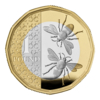 |
2022 to date |
Definitives 2023 UK £1 Designed by: Martin Jennings
|
